The Quiet
Pantheon
Four exits across thirty years in Southeast Asia, and Patrick Looram is building again — this time, with Greek gods.
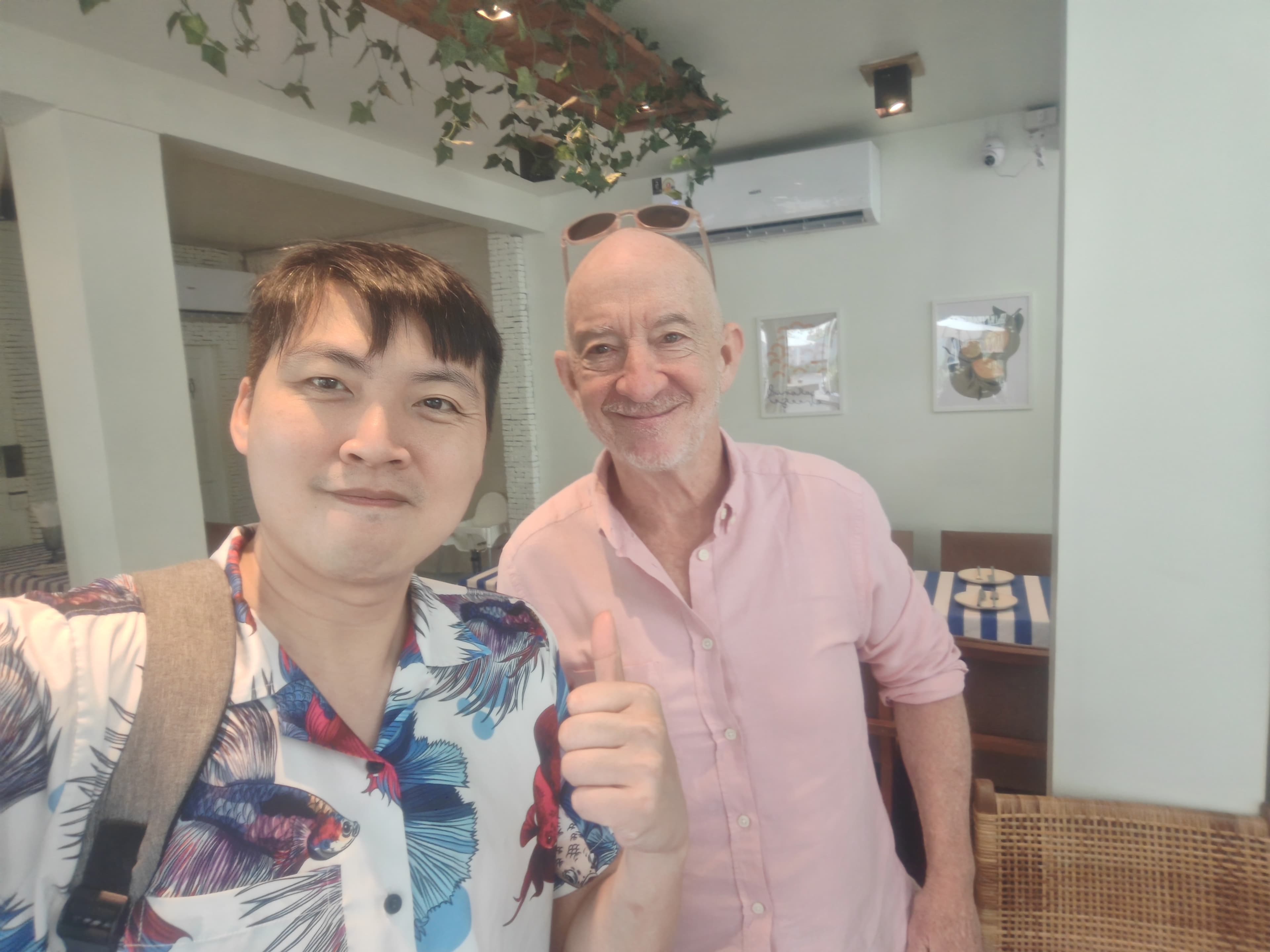
Patrick Looram (right) with the author over tea in Silom. The conversation began with semantics and ended with Greek mythology.
“Brand owners focus on what they do best — making and marketing great liquid. Distributors do everything else.”
— Patrick Looram, founder, Brand Connect Asia
There is a particular kind of business operator in Southeast Asia who is hard to spot from the outside. They don't do conference keynotes. They don't post on LinkedIn unless someone pushes them to. They've done four exits, two of them quietly, and if you ask them what they do they'll say something modest like “a bit of distribution” before changing the subject. Patrick Looram is one of them.
We met for tea at a quiet place in Silom on a Saturday in April. The plan was supposed to be a casual catch-up. Within ten minutes we were deep in the architecture of agentic AI systems, fine-tuning approaches, the difference between LoRAs and full model retraining, and why the alcohol industry has a semantic problem that out-of-the-box LLMs can't solve. Patrick is sixty-something and describes himself as semi-retired. The man is not retired.
Four acts, one geography
The career arc reads like a primer on how to build in Southeast Asia. Patrick started in management consulting at Technomic in the late 1980s, working out of Hong Kong, Singapore, and Ho Chi Minh City. Technomic was acquired by Renaissance Solutions in 1996. He went to Vietnam.
In 1998 he founded Meridian Research — Vietnam's leading pharmaceutical market research firm — and ran it for six years before selling it to IMS Health, the global category leader, in 2004. He took the proceeds and used them to seed Edge Asia, a digital marketing agency built from the ground up across five markets: Vietnam, Thailand, Malaysia, Singapore, and Indonesia.
Edge Asia became, by 2015, the largest independent digital marketing group in Southeast Asia. Four hundred and fifty employees. A client roster that included HSBC, Diageo, Visa, Samsung, Citibank. Sold to WPP that year. The pattern, by then, was visible: Patrick finds an industry where the regional infrastructure is missing, builds it, sells to the global incumbent, and starts again.
In 2017 he started Brand Connect — a premium drinks distribution business operating in Thailand. Sixteen hundred active customers across hotels, restaurants, retailers, gourmet bars. Ten years in. Highly profitable. He passed meaningful equity to his managing director and CRO and stepped back. That was, allegedly, the retirement.
The semantic layer
Brand Connect, like every distribution business of any scale, sits on a decade of operational data — sales, contracts, merchant compliance, supply chain, cash flow. Patrick describes the moment he started “playing around” with what AI could do on top of that data the way someone else might describe taking up gardening. Within months he had built an agentic layer that sat on top of his existing systems without modifying any of them.
The first hard problem, he explains, wasn't the model. It was language. The alcohol distribution industry has its own semantics, and an off-the-shelf model — even the best ones — gets them wrong. Ask a generic LLM “show me my top selling brands” and it returns SKUs, or product lines, or whatever it has been trained to call a brand. In drinks distribution, a brand is something more specific: a contracted exclusive relationship with a supplier, monitored against a portfolio of competing labels.
“You've got to teach it the whole semantic layer,” he says. “That's actually the moat. The model itself isn't a long-term competitive advantage. The semantic understanding of the industry is.”
“The model itself isn't a long-term competitive advantage. The semantic understanding of the industry is.”
A pantheon, named honestly
The platform is called Panthea. The architecture borrows directly from the Greek pantheon — a top-level orchestrator with specialised agents underneath, each with a clearly defined domain. There is something refreshing about this in 2026, an industry awash in three-letter AI startups with vague names and vaguer claims. The Greek gods are old enough to be unironic.
- Panthea · the orchestrator — routes requests to the right specialist agent
- Artemis · sales — surfaces customers about to churn, identifies whitespace
- Hermes · logistics — tracks shipments, forecasts cash flow
- Apollo · marketing — campaign execution and brand activation
- Athena · strategy — competitive positioning and portfolio decisions
- Delphi · discovery — onboards new customers via voice-first interview
The user-facing tagline is “Liquid Intelligence” — a line that lands the way good lines do, instantly memorable and a little bit overdetermined. The wedge isn't any single agent. It's the orchestrator itself, trained on the semantic layer — the piece that translates a question asked in plain language into the right sub-agent, with the right industry vocabulary, against the right slice of the operational data. Get the orchestrator right and every agent that plugs into it inherits the same business fluency. Get it wrong and every agent has to relearn what a brand, a venue, or a contract actually means in this industry. Anyone who has worked in trade marketing knows that semantic gap is the exact place where careers go to die.
Dozens of clones, one playbook
Patrick's commercial thesis is simple and Patrick-shaped. He built Panthea for himself, used it inside Brand Connect, hardened it against real distribution problems for six months, and then started showing it to the people he's known across thirty years in the region — drinks distributors in Hong Kong, China, Korea, Vietnam. Most of them are not direct competitors. They run parallel businesses in adjacent geographies, distributing overlapping but distinct portfolios.
“There are dozens of operators across Asia running businesses with the same shape as mine,” he says, with the exact tone of a man who already has a letter of intent from the first one. The first external customer is a distributor operating elsewhere in Southeast Asia with a similar profile to Brand Connect — same brands, different markets, same operational pain points.
The wedge is what he's building right now. The moat, he argues, is the second layer: a regional database of customer accounts, menu placements, and market share by category, scraped and maintained intelligently. Once a distributor in Bangkok can see where they sit against the four other premium-spirits operators in the country — and where the whitespace is — they don't leave. The US has a precedent: a company called Overproof did exactly this for the on-premise drinks market, and the major labels (Diageo, Pernod Ricard) now build on top of that data layer.
Patrick Looram — At a Glance
The fifth act
What is unusual about Patrick is not that he's building. People with four exits build again all the time, usually badly, usually as a vanity exercise. What is unusual is the methodology. He spent six months running Panthea inside his own business as a working tool — not a demo, not a beta, not a pilot. He passed meaningful equity to operators who could run Brand Connect without him day to day, which is the only way semi-retirement actually functions when you're built like Patrick. He's using AI tools to write most of the code himself, which means his cost of iteration is measured in tokens rather than salaries.
And the fundamental insight is one that most operators in his position miss entirely. The traditional SaaS model — charge per seat, lock in via switching costs — is dead in the new software world. The defensibility comes from somewhere else: from the industry-specific fine-tuning, from the proprietary external data layer, from the relationships in a specific vertical that nobody else has. Patrick has all three for drinks distribution in Asia. Nobody else does.
The conversation drifted, eventually, toward Vietnam — his spiritual home for eighteen years, and a market we both believe is the most bullish in the region right now. Brand Connect had a presence there before COVID; he's thinking about going back. The licence is in place. The infrastructure is ready. He told this to me casually, the way he tells everything, the way someone who has built and sold four companies tells you about the fifth.
When I asked him what was different this time, he laughed. “This is the most fun I've had in business,” he said. The tone was unguarded. He meant it.
The VXCES Read
Patrick Looram is the kind of operator who only exists in mature markets that have learned to build for themselves. Southeast Asia produces a small number of these people every generation. They build infrastructure quietly, sell it to the global majors, and start again. The fifth act — Panthea — is either going to be the most interesting B2B AI play in the region or it's going to be the prologue to the sixth. Either outcome is worth paying attention to.
Patrick Looram · Reference
Mark Koh is the founder of VXCES and Dunno Ventures. He met Patrick Looram for the first time over lunch in Bangkok in April 2026, and is currently evaluating Panthea for the Dunno Ventures portfolio.